In 9 CE, three Roman legions marched into the forests of Germania. They never returned.
The man behind their destruction was Arminius, a Germanic warrior who had once served Rome itself. He had gained Roman citizenship, risen through the ranks of the Roman military, and learned firsthand how Rome’s armies fought.
Table of Contents
Then he turned that knowledge against them.
At the Battle of the Teutoburg Forest, Arminius helped lure the forces of the Roman commander Publius Quinctilius Varus into a devastating ambush that destroyed Legions XVII, XVIII, and XIX.
But Arminius’s story did not end with Rome’s humiliation at Teutoburg. He would go on to face renewed Roman invasions, clash with Germanicus, struggle to unite the Germanic tribes, and ultimately die at the hands of his own people.
Arminius at a Glance
- Born: Around 18 or 17 BCE
- Tribe: Cherusci
- Roman status: Citizen, equestrian, and military officer
- Best known for: Defeating three Roman legions at the Battle of the Teutoburg Forest
- Main Roman rival: Germanicus
- Died: Around 21 CE
- Cause of death: Assassinated by members of his own family or political circle
Arminius in the Service of Rome
Before Arminius became the architect of one of Rome’s greatest military disasters, he had served the empire himself.
Arminius was born into the Cherusci, a Germanic tribe whose lands lay east of the Rhine. He came from a prominent family and appears to have spent part of his youth under Roman influence. Some historians believe he may have been taken to Rome as a hostage, a practice the Romans sometimes used to secure the loyalty of important tribal families, although the surviving evidence about his early life is limited.
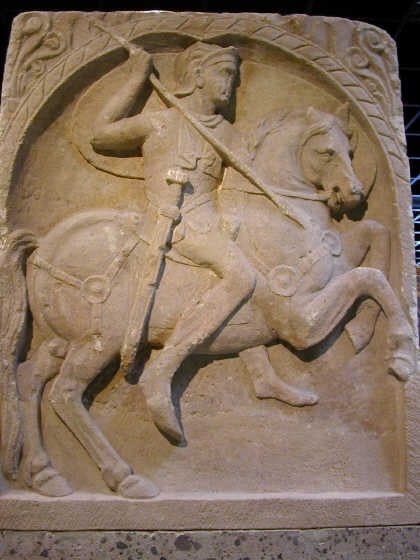
What is clear is that Arminius became deeply integrated into the Roman military system. He served with Roman forces, gained Roman citizenship, and was granted equestrian status, placing him among a privileged social class within the empire.
What Arminius Learned from the Roman Army
His military experience gave him something few Germanic leaders possessed: firsthand knowledge of:
- Roman military discipline and command structures
- Legionary formations and battlefield tactics
- The army’s reliance on organized supply lines
- The difficulty Roman soldiers faced in forests and marshes
- The expectations and assumptions of Roman commanders
Few Germanic leaders possessed such detailed knowledge of Rome’s military system. It would prove invaluable when Arminius turned against the empire.
By the time Publius Quinctilius Varus was governing Germania, Arminius was trusted enough to operate between the Roman authorities and the Germanic tribes. His position made him a useful intermediary, but it also gave him valuable insight into Roman movements and weaknesses.
Exactly when Arminius decided to betray Rome is unknown. The surviving sources do not reveal his private motives, and most were written from a Roman perspective. Growing resentment toward Roman taxation, legal control, and attempts to impose greater authority over the Germanic tribes may have played a role, but whether Arminius had long planned his rebellion or gradually turned against Rome remains uncertain.
What is certain is that the military experience Rome had given him would soon be used against the empire itself.
Arminius Turns Against Rome
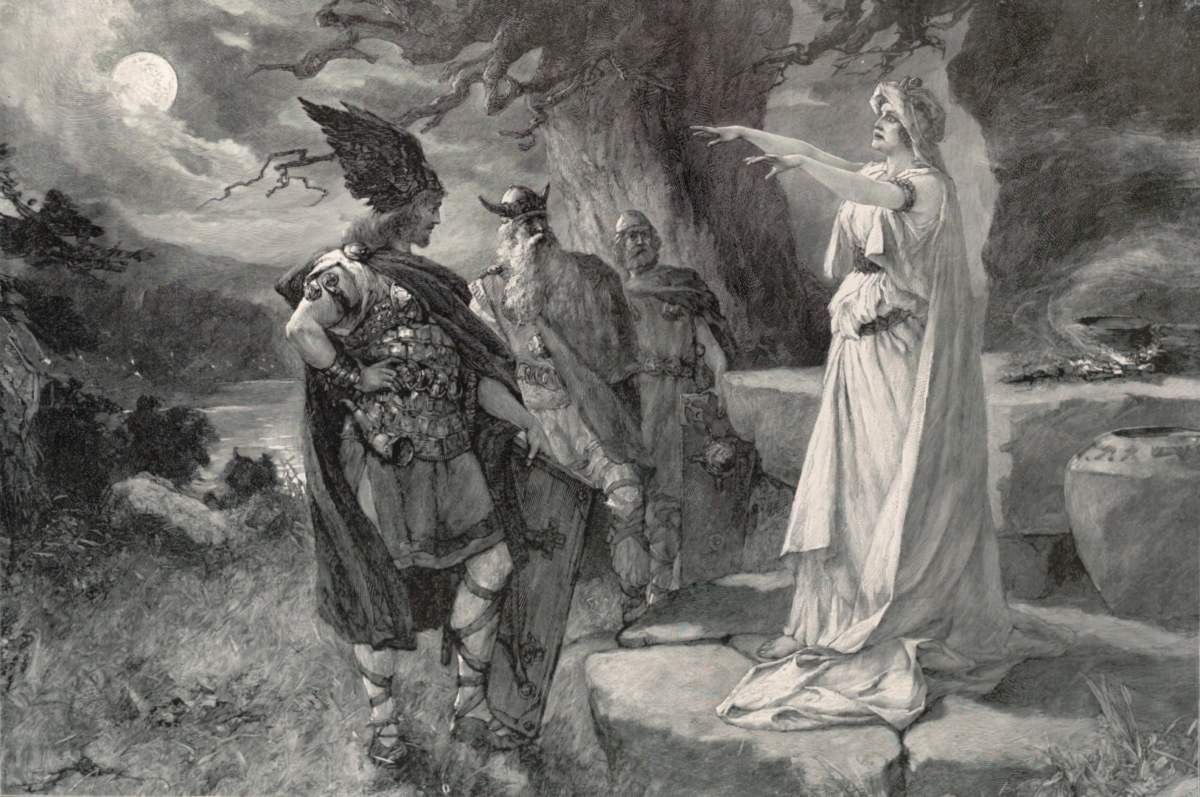
By 9 CE, Arminius had begun secretly working against the empire he had once served. Using his position as a trusted Roman ally, he built support among several Germanic leaders while concealing his intentions from Publius Quinctilius Varus.
As the Roman campaigning season drew to a close, Varus prepared to move his army toward its winter quarters near the Rhine. According to the ancient accounts, reports then reached him of unrest among a distant Germanic people. The disturbance appears to have been deliberately arranged as part of the conspiracy against Rome.
Arminius encouraged Varus to respond.
How Arminius Deceived Varus
Rather than returning by a familiar and more secure route, the Roman commander led his army through territory he believed to be friendly. This was exactly what Arminius and his allies needed. It drew three Roman legions—XVII, XVIII and XIX—along with auxiliary troops, cavalry, baggage and camp followers into terrain where the Romans would struggle to fight in their usual disciplined formations.
There was at least one warning. Segestes, a Cheruscan leader who opposed Arminius, reportedly told Varus that a conspiracy was underway and urged him to arrest Arminius and the other plotters. Varus ignored the warning, apparently continuing to trust the man who had served Rome and fought alongside its forces.
That trust proved disastrous.
Arminius’s experience in Roman service gave him an intimate understanding of the army he was preparing to attack. He knew its strengths, but more importantly, he understood the conditions under which those strengths could be neutralized. Roman legions were at their most formidable when they could form organized battle lines on suitable ground. In forests, marshes, and narrow routes, their ability to maneuver and maintain formation could be severely restricted.
Arminius and his allies were therefore not preparing to meet Rome in a conventional battle. They were preparing to turn the landscape itself into a weapon.
Rome had successfully overcome powerful tribal coalitions before. At the Battle of Alesia, Julius Caesar defeated the forces of Vercingetorix and effectively broke organized Gallic resistance—but at Teutoburg, the outcome would be dramatically different.
The result would become one of the most devastating military disasters in Roman history.
The Battle of the Teutoburg Forest
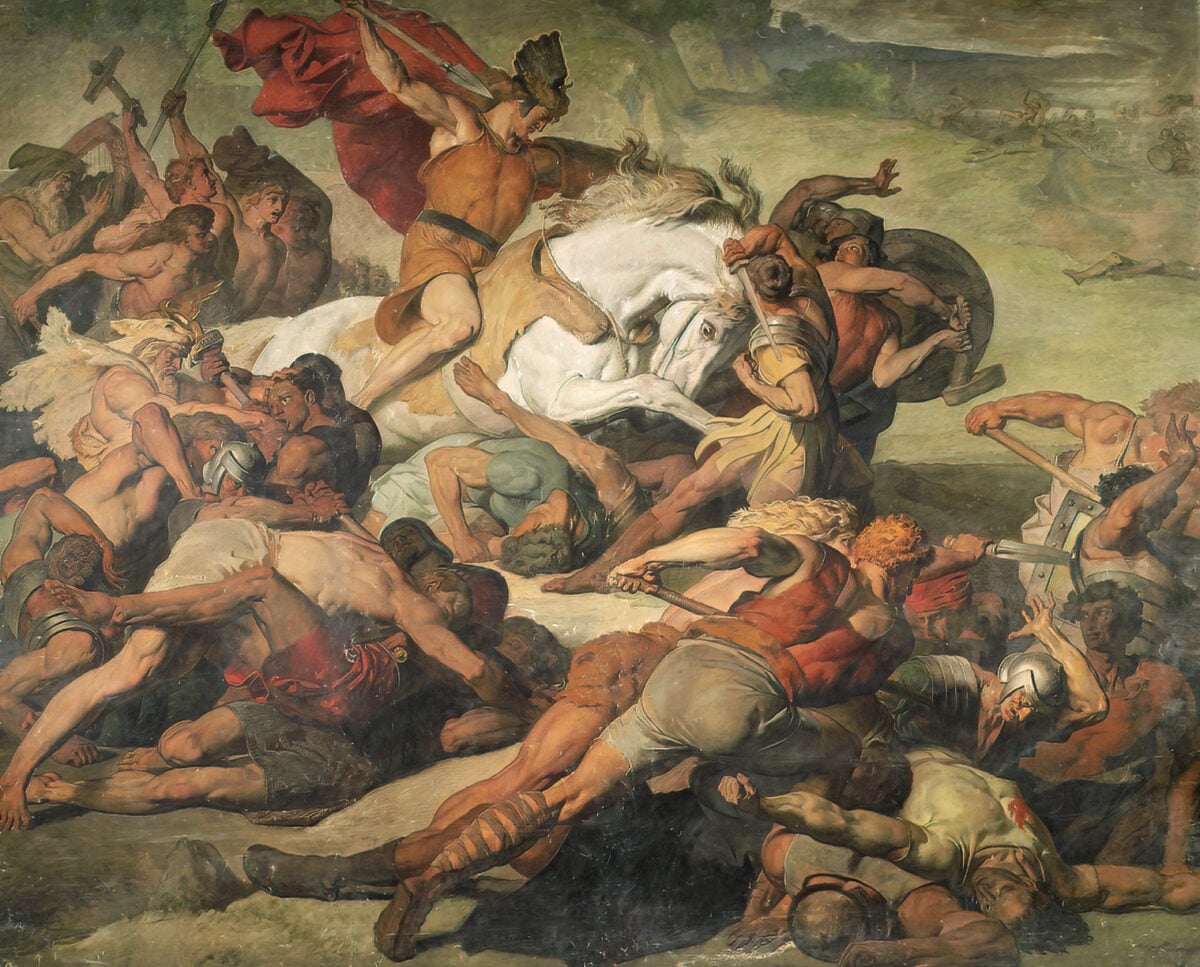
In September 9 CE, Publius Quinctilius Varus led three Roman legions—XVII, XVIII, and XIX—along with auxiliary troops, cavalry, and a large baggage train through the unfamiliar terrain of Germania. What followed was not simply a single ambush, but a prolonged disaster that unfolded as Arminius and his allies repeatedly attacked the vulnerable Roman column.
The Romans were particularly exposed while on the march. Soldiers, baggage animals, servants, and camp followers stretched along the route, making it difficult for the legions to maintain the tight formations that made them so formidable on an open battlefield.
Arminius exploited this weakness.
How the Roman Army Was Trapped
Over several days, a combination of tactics, terrain, and deteriorating conditions gradually destroyed Varus’s army:
- The Roman column became dangerously extended. Soldiers, baggage animals, servants, and camp followers were spread along the route.
- Germanic warriors launched repeated attacks. They struck vulnerable sections of the column before withdrawing into the surrounding terrain.
- Forests and marshes restricted Roman movement. The legions struggled to form the organized battle lines they relied upon.
- Heavy rain and wind worsened conditions. Mud, poor visibility, and damaged equipment made it harder for the Romans to regroup.
- The attacks continued as the army weakened. Exhaustion and mounting losses eventually left the legions unable to organize an effective defense.
Germanic warriors attacked sections of the extended column before withdrawing into terrain where the Romans struggled to pursue them. Dense woodland, uneven ground, and increasingly poor weather added to the confusion. Heavy rain and strong winds are described in the ancient accounts, making movement more difficult and further disrupting Roman formations.
The Romans attempted to regroup and continue their march, but Arminius’s forces maintained the pressure. Rather than confronting the legions in the kind of conventional battle the Romans were trained to dominate, the Germanic warriors repeatedly struck when the terrain and circumstances favored them.
Arminius was not the only enemy to exploit Roman vulnerabilities rather than face the legions on their preferred terms. In Asia Minor, the forces of Pontus famously used poisonous “mad honey” to incapacitate and massacre Roman soldiers.
What Archaeology Reveals at Kalkriese
One of the most important sources of archaeological evidence for the battle is Kalkriese in modern Germany, where decades of archaeological investigation have uncovered evidence of a major confrontation between Roman and Germanic forces.
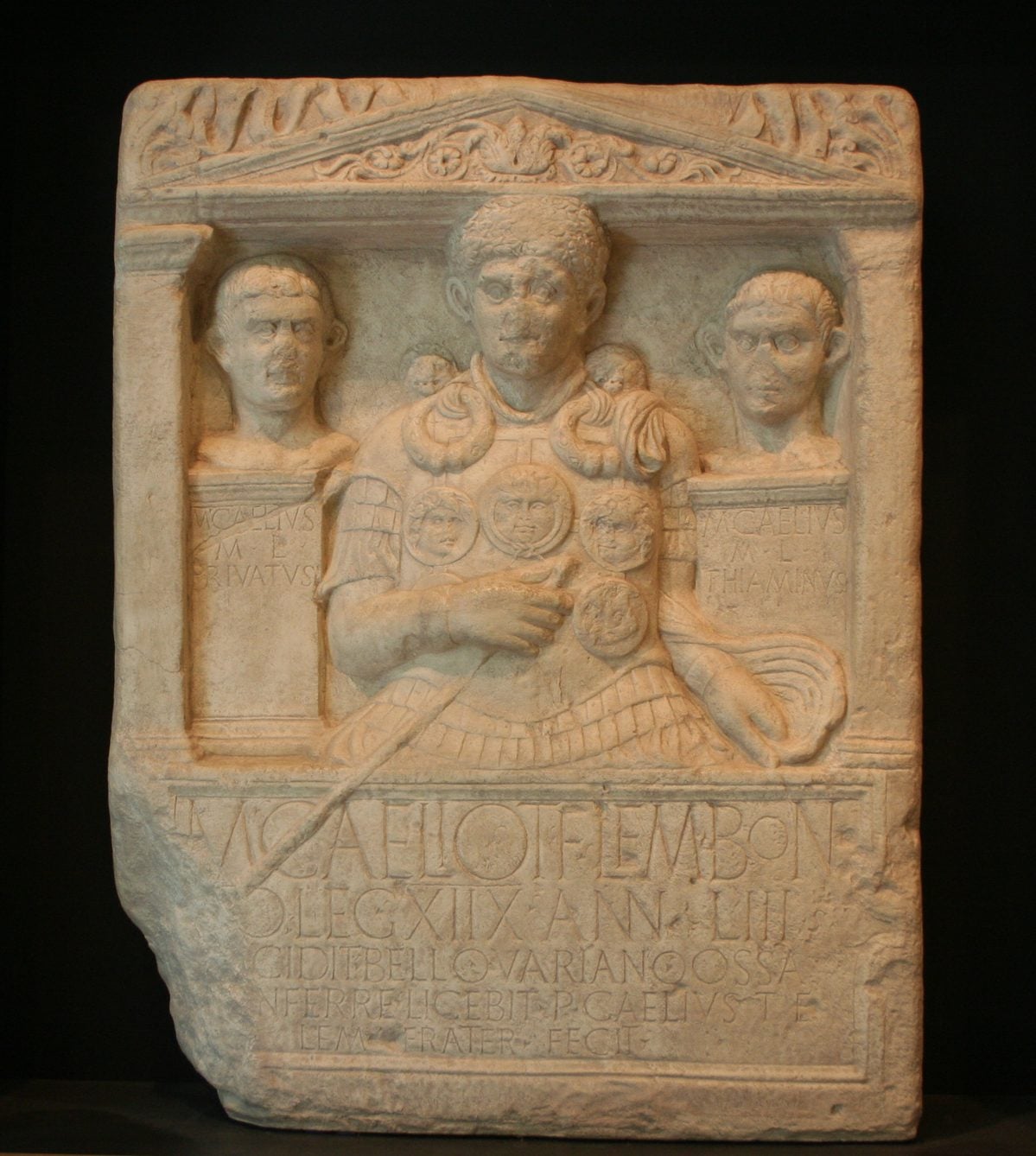
Archaeologists have uncovered Roman military equipment, coins, human remains, and traces of a substantial man-made barrier associated with the fighting. The barrier appears to have been constructed along a narrow corridor between Kalkriese Hill and marshy ground, creating a position from which Germanic warriors could attack Roman troops forced through restricted terrain.
The Destruction of Varus’s Legions
By this stage, Varus’s army had been battered by repeated attacks, exhaustion, and deteriorating conditions. The Romans could no longer effectively organize the kind of coordinated defense that might have saved them.
The final collapse was catastrophic.
Facing defeat and the prospect of capture, Varus and several of his senior officers took their own lives. Large numbers of Roman soldiers were killed, while others were captured or sacrificed in the aftermath. The three legions effectively ceased to exist, and their numbers—XVII, XVIII and XIX—were never again used for Roman legions.
The destruction of Legions XVII, XVIII and XIX is one of the most dramatic examples of the uncertain and sometimes mysterious fates of individual Roman legions, some of which seemingly vanished from the historical record.
The scale of the defeat stunned Rome. An army commanded by an experienced Roman governor had been destroyed not by another great empire, but by an alliance of Germanic peoples led by a man who had once served in Rome’s own military.
Yet the Battle of the Teutoburg Forest did not immediately end Roman attempts to control Germania. Roman armies would return across the Rhine, and within a few years Arminius would find himself facing one of Rome’s most formidable commanders: Germanicus.
Rome Reels from the Teutoburg Disaster
News of the destruction of Varus and three Roman legions sent shockwaves through the empire. Rome had suffered major defeats before, but the scale of the disaster in Germania was extraordinary: an entire field army had effectively been wiped out, along with its commander and much of its supporting force.
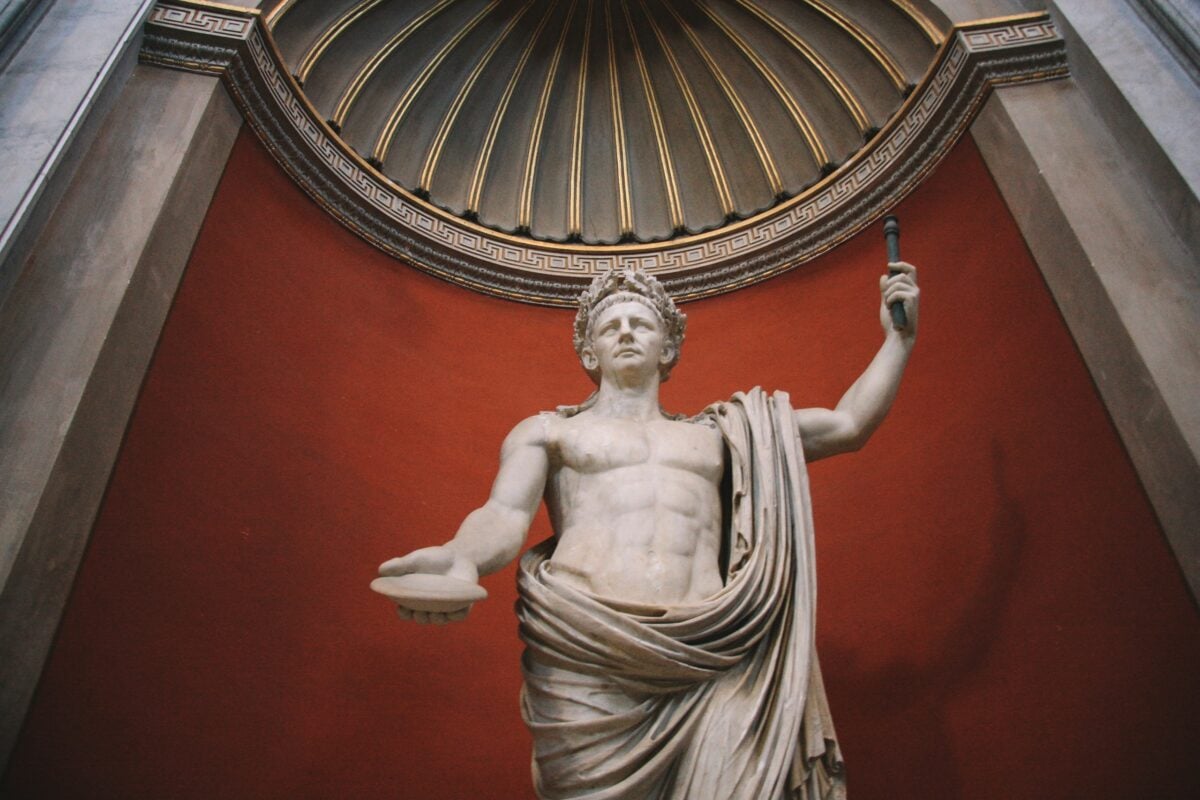
The defeat deeply affected Emperor Augustus. According to the Roman biographer Suetonius, Augustus was so shaken that for months he neglected his hair and beard and was sometimes heard crying, “Quinctilius Varus, give me back my legions!” Suetonius also reports that Augustus treated the anniversary of the disaster as a day of mourning.
Rome immediately took precautions against the possibility that the defeat could trigger further instability. Augustus strengthened military preparedness, retained experienced provincial governors in their posts, and worked to ensure that the empire’s allies remained loyal.
Yet Teutoburg did not bring an immediate end to Roman operations in Germania.
Roman forces remained concentrated along the Rhine, and further expeditions were launched east of the river. The empire still needed to defend its frontier, restore its military reputation, and respond to the coalition that Arminius had created.
The battle nevertheless changed the strategic situation. Before 9 CE, Rome had been attempting to extend lasting control deep into Germania. After Varus’s defeat, holding territory beyond the Rhine became a far more difficult and costly proposition.
The question was no longer simply whether Rome could defeat the Germanic tribes in battle. It was whether permanent conquest was worth the soldiers, money, and continued warfare required to maintain it.
That question would soon fall to Augustus’s successor, Tiberius—and to one of Rome’s most celebrated commanders, Germanicus.
Why Rome Abandoned the Conquest of Germania
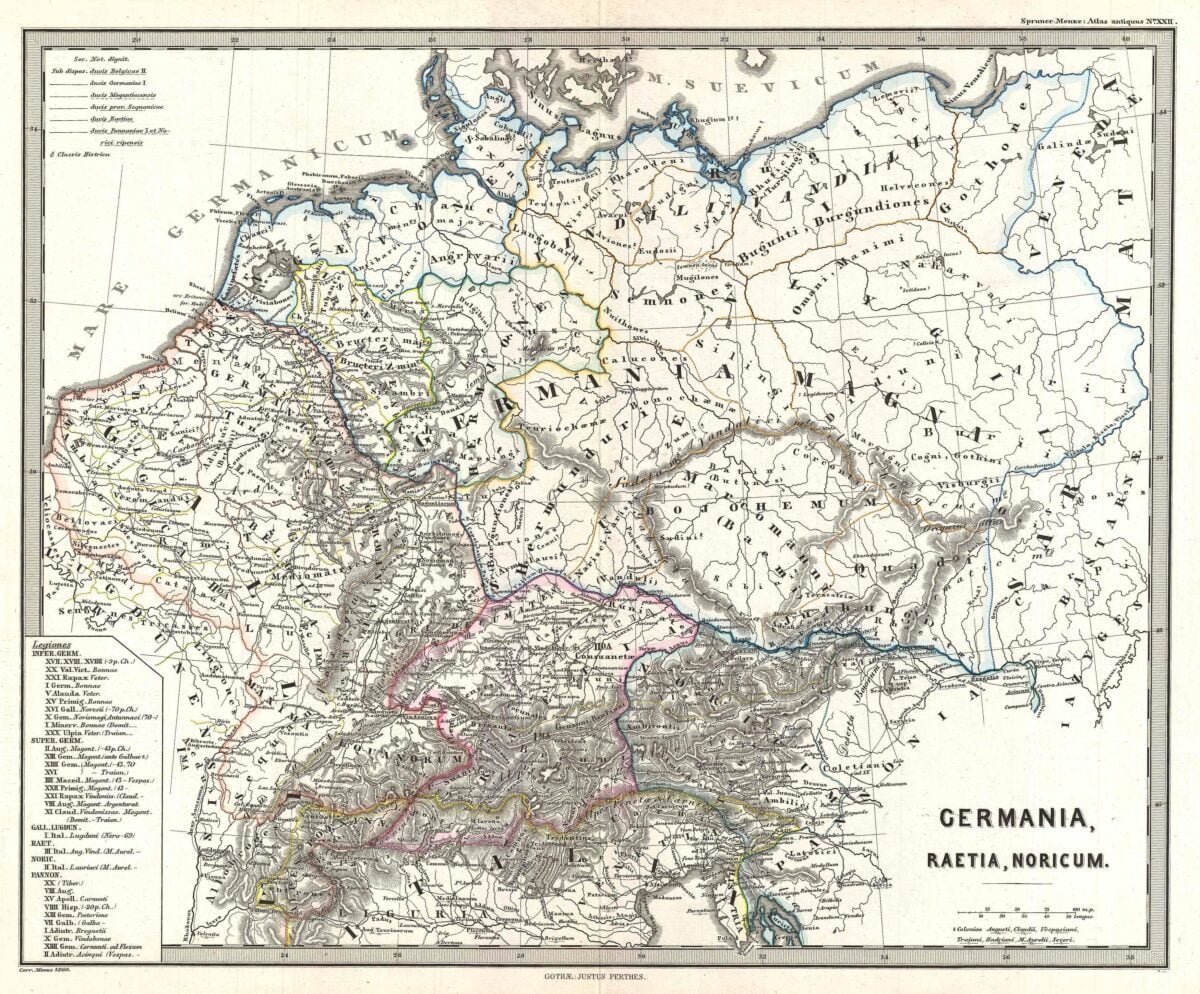
Despite the catastrophe at the Teutoburg Forest, Rome did not immediately abandon its ambitions east of the Rhine. Roman armies returned to Germania repeatedly, and between 14 and 16 CE Germanicus led major campaigns against Arminius and his allies.
Germanicus won several engagements, inflicted heavy losses on the Germanic forces, and recovered two of the three legionary eagles lost with Varus. Roman troops even returned to the site of the Teutoburg disaster, where they encountered the remains of soldiers who had fallen several years earlier.
Why Rome Could Win Battles but Not Hold Germania
Yet military victories did not translate into permanent control.
Several factors made permanent conquest increasingly unattractive:
- Organized resistance remained. Arminius and other Germanic leaders were still capable of rallying opposition.
- The terrain complicated campaigns. Forests, marshes, and long overland routes made Roman operations difficult.
- Occupation required substantial resources. Holding the region would demand soldiers, forts, supplies, and continued spending.
- Victories did not guarantee control. Rome could defeat Germanic armies without establishing lasting political authority.
- The Rhine offered a practical frontier. Rome could protect its interests more efficiently by strengthening the river boundary.
- Internal rivalries could weaken resistance. Tiberius believed the Germanic tribes might exhaust themselves through their own conflicts.
The Romans had demonstrated that they could march east of the Rhine and defeat Germanic armies. Conquering the region was one thing; holding it was another.
In 16 CE, Emperor Tiberius brought Germanicus’s large-scale campaigns in Germania to an end. According to the Roman historian Tacitus, Germanicus wanted another campaigning season and believed he could force the enemy into submission. Tiberius disagreed. He argued that Rome had taken sufficient revenge and that the Germanic tribes could be left to weaken themselves through their own internal rivalries.
The decision proved remarkably durable.
The Rhine Becomes Rome’s Frontier
Rather than attempting to turn Germania east of the Rhine into Roman provinces, the empire increasingly concentrated on defending and strengthening the frontier. The Rhine became one of Rome’s most important boundaries in northern Europe, protected by forts, military bases and large numbers of troops.
This did not mean that Romans never crossed the Rhine again. Roman armies continued to campaign beyond the frontier when necessary, and Rome maintained diplomatic, political and economic relationships with Germanic peoples for centuries. What disappeared was the sustained attempt to permanently conquer and administer much of Germania beyond the river.
The Battle of the Teutoburg Forest therefore did not single-handedly stop Roman expansion overnight. Instead, it dramatically altered the cost and difficulty of conquest. The campaigns that followed showed that Rome could still defeat Arminius on the battlefield, but they also demonstrated how difficult it would be to transform those victories into lasting control.
In the end, Arminius had achieved something far greater than a single spectacular victory. Rome had returned to Germania seeking revenge, but it ultimately chose not to rebuild the provincial system that Varus had attempted to impose east of the Rhine.
Arminius vs. Germanicus
The destruction of Varus’s army did not end the struggle between Arminius and Rome. In the years that followed, the empire returned to Germania in force, determined to restore its military prestige and punish those responsible for the disaster.
At the center of Rome’s response was Germanicus, one of the most celebrated commanders of his generation and the adopted son of Emperor Tiberius. Between 14 and 16 CE, he led a series of major campaigns east of the Rhine against Arminius and his allies.
Germanicus achieved several important successes. Roman forces struck deep into Germanic territory, defeated hostile tribes, and recovered two of the three legionary eagles lost with Varus in 9 CE. In 15 CE, Germanicus also visited the site of the Teutoburg disaster, where his soldiers gathered and buried the remains of Romans who had lain exposed for years.
Arminius, meanwhile, continued attempting to rally the Cherusci and neighboring tribes against Rome. His greatest advantage remained his understanding of both Roman warfare and the German landscape. Rather than allowing the Romans to dictate the terms of every engagement, he sought to exploit forests, marshes, and difficult terrain where the legions could be more vulnerable.
Germanicus understood this weakness. By the campaign of 16 CE, he had adapted his strategy, using rivers and the North Sea to move troops and supplies while reducing the dangers posed by long overland marches through hostile territory.
The Battle of Idistaviso
The two sides eventually met in a major battle at Idistaviso, near the Weser River. Unlike the disaster at Teutoburg, the Romans were able to fight on ground much better suited to their formations. Germanicus won a major victory, and Arminius escaped despite suffering wounds during the fighting.
Further combat followed at the Angrivarian Wall, where Roman forces again claimed victory. Yet despite these battlefield successes, Germanicus failed to destroy Arminius or permanently subdue the Germanic tribes.
That distinction was crucial.
Rome had shown that Teutoburg had not made its armies incapable of operating beyond the Rhine. Rome could claim battlefield victories, but Arminius had survived its attempt at revenge. Germanicus could invade Germania and defeat Germanic forces in open battle, yet he could not easily transform those victories into permanent political control.
What Did Each Side Achieve?
| Germanicus and Rome | Arminius and His Allies |
|---|---|
| Won major conventional battles | Avoided complete destruction |
| Recovered two lost legionary eagles | Continued resisting Roman control |
| Restored some of Rome’s military prestige | Prevented Rome from securing lasting authority |
| Demonstrated that Roman armies could still campaign beyond the Rhine | Made permanent conquest increasingly costly and difficult |
Germanicus wanted to continue the war, but Tiberius brought the large-scale campaigns to an end after the 16 CE campaign season. Germanicus returned to Rome and celebrated a triumph in 17 CE.
Arminius had survived Rome’s attempt at revenge. Although he had suffered defeats in battle, the larger question remained unresolved: was Germania worth the enormous effort required to conquer and hold it?
For Tiberius, the answer would ultimately be no.
Germanicus would later become one of the most celebrated figures of the Julio-Claudian dynasty and the father of the future emperor Caligula.
Arminius Strives to Become King
With the major Roman campaigns in Germania at an end, Arminius no longer faced the same immediate threat from across the Rhine. But peace with Rome did not bring peace among the Germanic tribes.
Without a common Roman enemy to unite them, old rivalries quickly resurfaced.
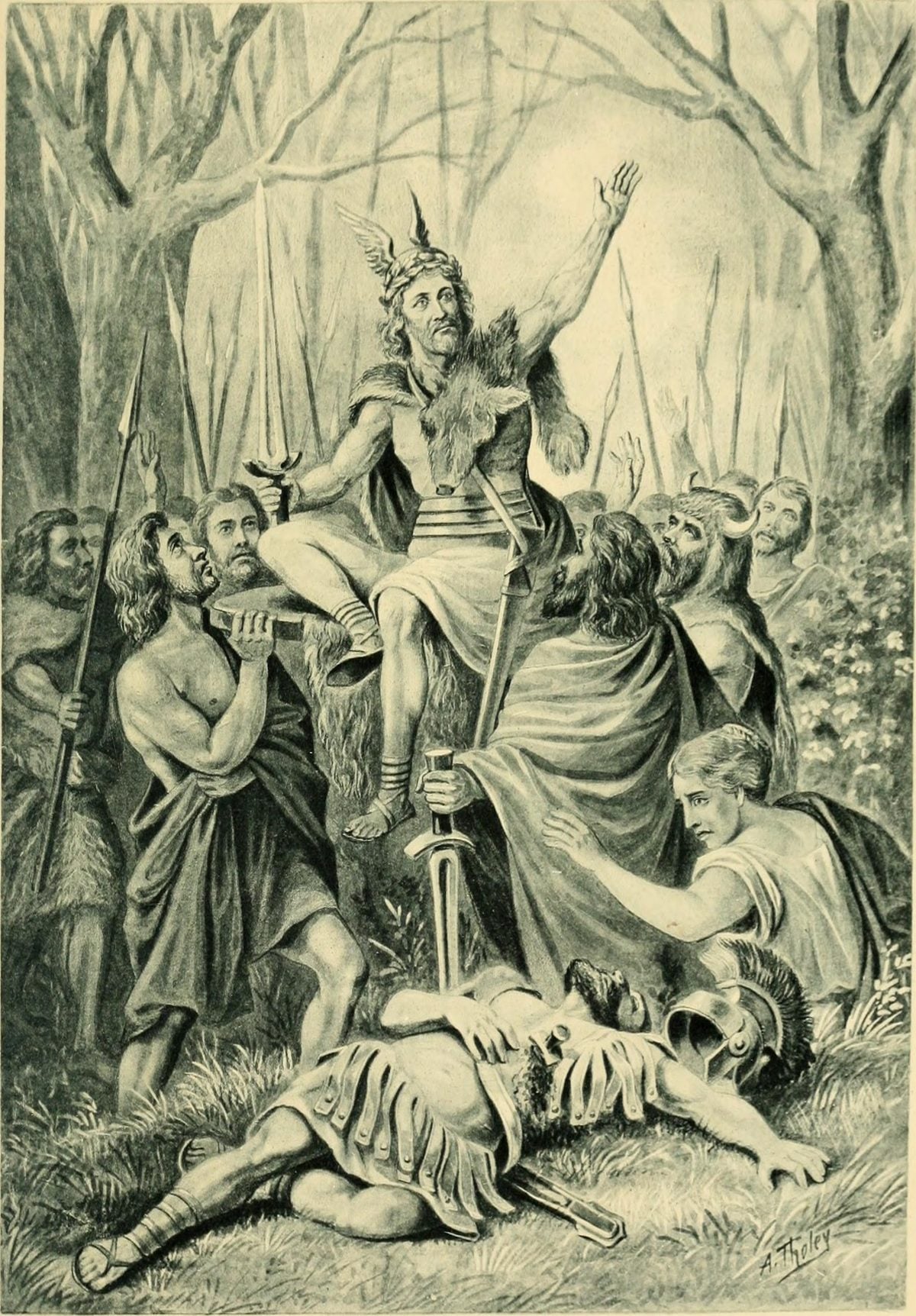
One of Arminius’s greatest rivals was Maroboduus, king of the Marcomanni, who had built a powerful confederation in central Europe. The two leaders represented competing centers of Germanic power, and their rivalry eventually erupted into war.
Arminius was able to draw support from several tribes that had previously been aligned with Maroboduus, including the Semnones and Langobardi. Tacitus portrays Arminius as rallying his followers around the idea of liberty, reminding them of the defeat of Varus and presenting himself as the man who had driven Roman power back from their lands.
The resulting battle between Arminius and Maroboduus was fiercely contested. Neither side achieved an immediate decisive victory, but Maroboduus ultimately lost support, retreated, and was eventually driven from power.
Arminius’s own position grew stronger.
His position now rested on several major accomplishments:
- He had destroyed Varus’s army.
- He had survived years of Roman retaliation.
- He had helped push Maroboduus from power.
- He had attracted support from several Germanic tribes.
- He could present himself as a champion of freedom from Roman rule.
Yet those achievements also made rival leaders increasingly wary of his ambitions.
Arminius Turns His Attention to Kingship
Yet his increasing power created a new problem. According to Tacitus, Arminius eventually “began to aim at kingship.” For many of the people who had followed him against Rome, however, replacing Roman domination with the rule of a single Germanic king was hardly an attractive alternative.
The same independence that had helped Arminius rally resistance against Rome now worked against his own ambitions.
Opposition emerged from rival leaders and even from within his wider family. Germanic political loyalties were often personal and tribal rather than centralized, and Arminius struggled to transform his military prestige into lasting authority over the people he had helped unite against Rome.
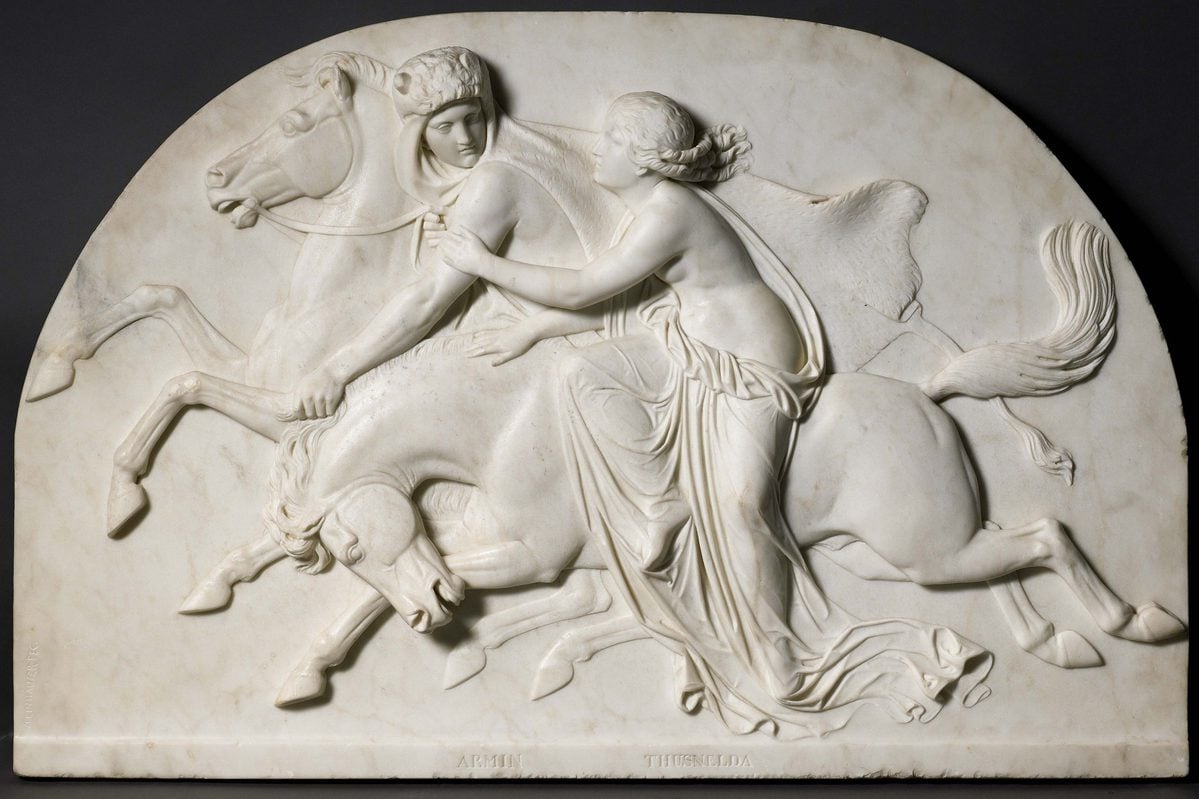
His own family illustrated those divisions particularly clearly. Arminius’s brother Flavus had remained loyal to Rome and served in the Roman army. During Germanicus’s campaigns, the brothers famously confronted one another across the Weser River, with Flavus defending Roman power while Arminius appealed to ancestral freedom and resistance to foreign rule.
Arminius had succeeded in resisting one of the most powerful empires in the ancient world. But creating a lasting political order among the Germanic tribes would prove far more difficult.
How Did Arminius Die?
Arminius survived Rome’s attempts to defeat him, but he could not escape the political rivalries within Germania.
After the end of the major Roman campaigns, his growing power and apparent ambition to become king created increasing opposition among the Cherusci and other Germanic leaders. The same people who had supported Arminius in resisting Roman domination were not necessarily willing to accept his authority over them.
According to the Roman historian Tacitus, Arminius eventually faced resistance from his own countrymen and was killed through the treachery of his relatives.
He died around 21 CE, approximately twelve years after his victory over Varus in the Teutoburg Forest. The surviving sources do not provide a detailed account of the assassination, so the identities and exact motives of those responsible remain uncertain.
His death brought an extraordinary career to an abrupt end. Arminius had risen through the Roman military system, turned against the empire, destroyed three Roman legions, and survived years of Roman retaliation. Yet in the end, he was killed not by Rome, but by members of his own people.
Tacitus nevertheless remembered him in remarkable terms, describing Arminius as the “liberator of Germany” and emphasizing that he had challenged Rome at the height of its power.
Arminius failed to create the united Germanic kingdom he appears to have sought, but his victory over Varus ensured that his name would survive long after his death.
Arminius’s Legacy
Arminius died without creating the united Germanic kingdom he appears to have sought, but his victory over Rome gave him a legacy that would survive for nearly two thousand years.
Even Roman historians recognized the significance of what he had achieved. Writing roughly a century after the Battle of the Teutoburg Forest, Tacitus described Arminius as the “liberator of Germany,” praising him for challenging Rome not during a period of weakness, but when the empire was at the height of its power.
His greatest legacy remained the destruction of Varus’s army in 9 CE. The victory did not immediately end Roman military operations east of the Rhine, but it dealt a devastating blow to Rome’s attempt to establish permanent control over large parts of Germania. Later campaigns demonstrated that Roman armies could still defeat Germanic forces, yet Rome ultimately chose not to recreate the system of provincial rule that had been developing before the disaster.
From Arminius to Hermann
For centuries after his death, however, Arminius was not the great national hero he would later become. Much of what was known about him survived in Roman texts, particularly the writings of Tacitus, whose works were rediscovered and circulated more widely in Europe during the Renaissance.
Arminius subsequently became better known in the German-speaking world as “Hermann.” Writers and intellectuals increasingly portrayed him as an early defender of German freedom against foreign domination, even though the Germanic peoples of Arminius’s lifetime did not possess a single German national identity in the modern sense.
His reputation grew particularly strongly during the rise of German nationalism in the eighteenth and nineteenth centuries. The victory over Rome was reinterpreted as a foundational moment in German history, and Arminius became a symbol of unity, independence and resistance to foreign rule.
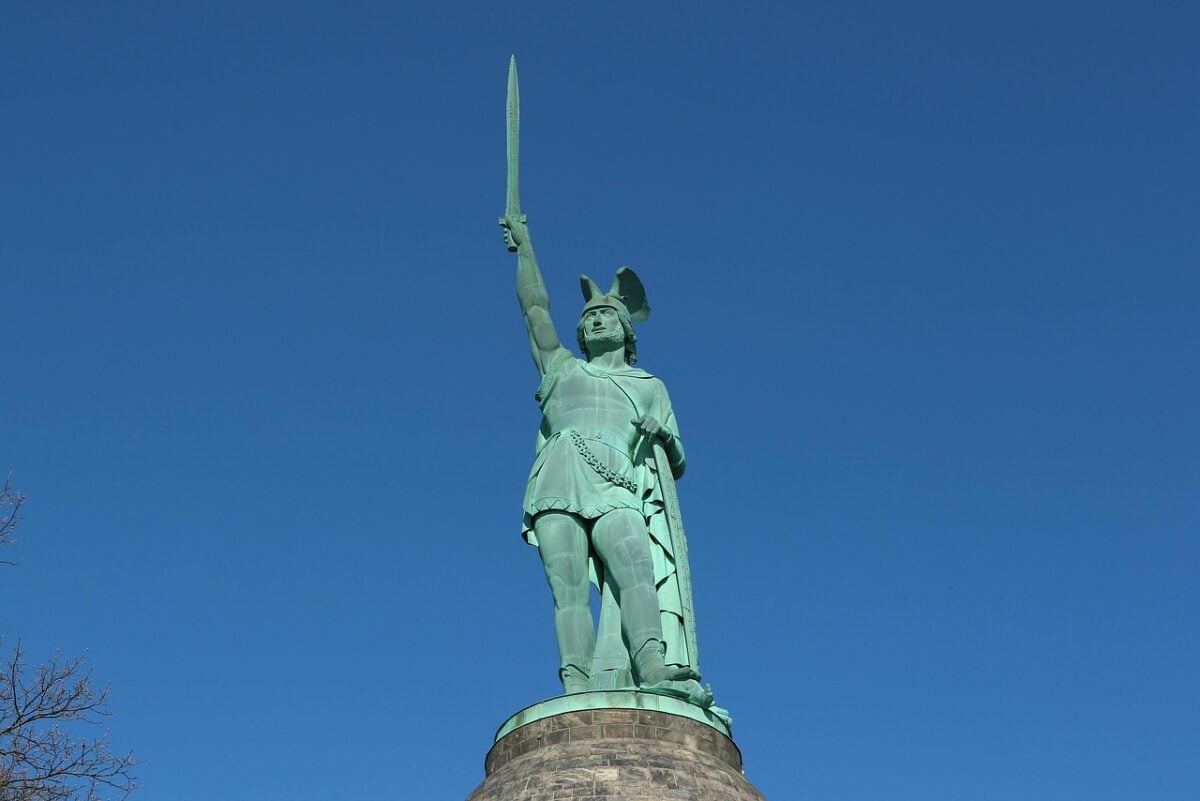
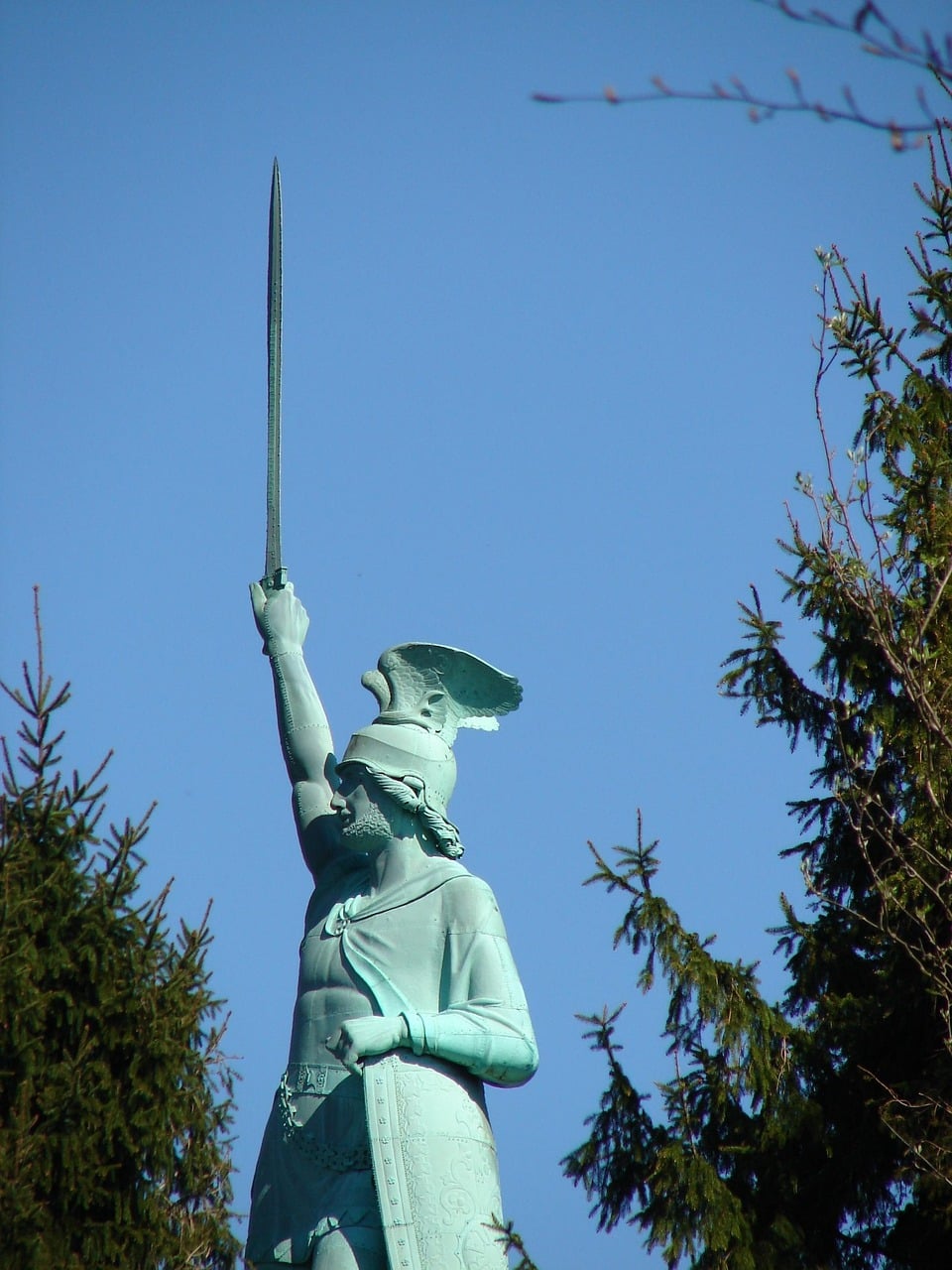
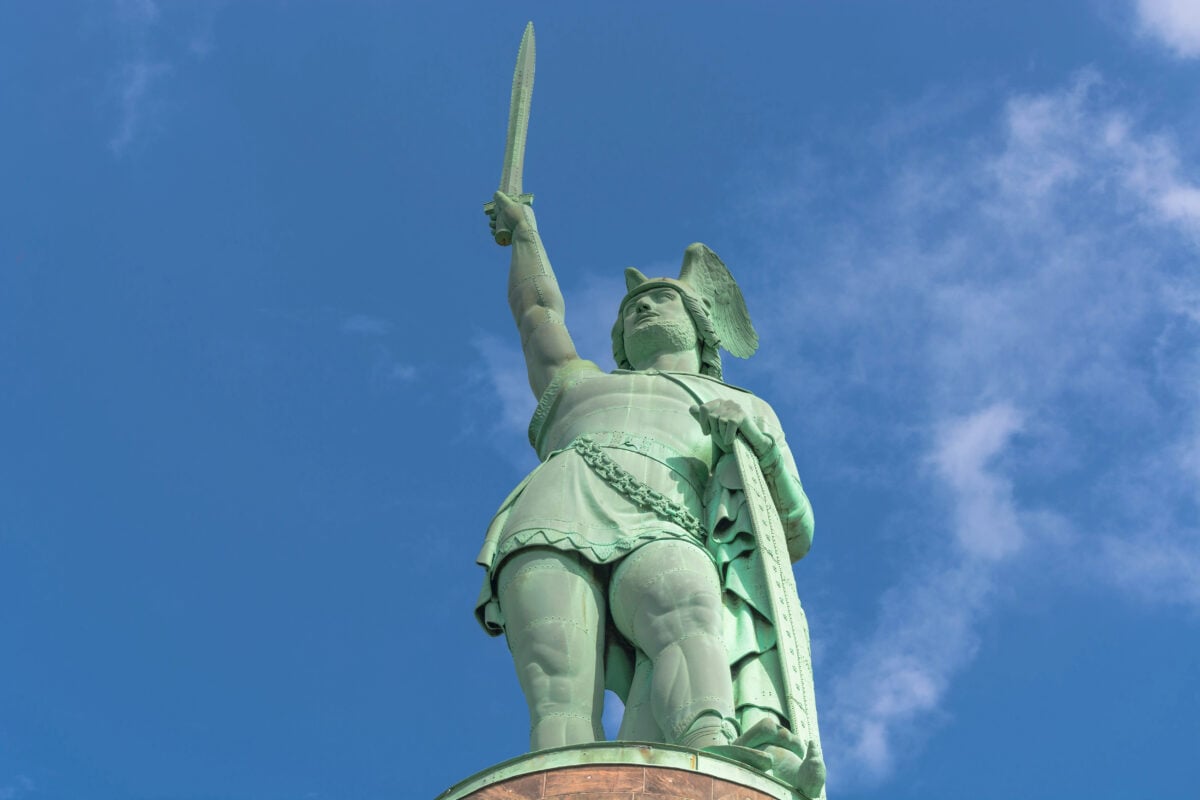
The most visible expression of this later reputation is the Hermannsdenkmal, or Hermann Monument, near Detmold in Germany. Completed in 1875, the enormous monument depicts Arminius raising a sword above the Teutoburg Forest and reflects the nationalist meaning that had become attached to his story centuries after his death.
The Historical Arminius vs. the Legend
Over time, Arminius acquired several different identities:
- To Roman writers, he was a dangerous enemy who had humiliated the empire.
- To later German nationalists, “Hermann” became a symbol of unity and resistance to foreign domination.
- To modern historians, he was a Cheruscan leader operating within a fragmented world of tribal alliances and personal rivalries.
These interpretations reveal as much about the societies remembering Arminius as they do about the historical man himself.
Modern historians view that legacy more cautiously. Arminius was not fighting to create the nation of Germany that emerged in the nineteenth century, nor did he permanently unite the Germanic peoples. He was a Cheruscan leader operating in a fragmented political world of tribes, alliances, and rivalries.
That distinction does not diminish what he accomplished.
Arminius understood the Roman military system from the inside and successfully exploited its vulnerabilities. He united enough Germanic warriors to destroy three Roman legions, survived Rome’s campaigns of revenge, and became one of the most formidable opponents the empire encountered during the reigns of Augustus and Tiberius.
More than two thousand years later, his story remains remarkable for one central irony: Rome helped train the man who would inflict one of the greatest defeats in its history.
Arminius was one of several figures whose resistance to Roman power would echo long after their deaths. Another was Spartacus, whose rebellion repeatedly defeated Roman armies before Rome finally crushed the revolt.
Explore More Battles and Enemies of Rome
Arminius was far from the only commander to expose the vulnerabilities of Rome’s seemingly unstoppable military machine. Centuries of Roman expansion brought the republic and empire into conflict with some of the ancient world’s most formidable leaders.
Discover how Hannibal inflicted one of Rome’s most devastating defeats during his legendary war against the Roman Republic, or follow the story of Spartacus and the rebellion that repeatedly defeated Roman armies.
For another example of Rome confronting a coalition of tribal warriors, explore the Battle of Alesia, where Julius Caesar faced Vercingetorix and the Gauls in one of his most famous victories.
And if the disappearance of Legions XVII, XVIII, and XIX at Teutoburg caught your attention, discover another enduring Roman military mystery: what happened to the Ninth Legion?
What Do You Think?
Was Arminius a defender of Germanic freedom, an ambitious leader seeking power, or simply one of Rome’s most formidable enemies?
Let us know what you think in the comments below—and whether you believe Rome could have conquered Germania if it had continued the war.



.jpg)
.png)

_at_the_battle_of_the_Teutoburg_Forest_in_9_CE_by_Peter_Jannsen,_1873,_with_painting_creases_and_damage_removed.jpg)

,_by_Augustus_Tholey_.jpg)
